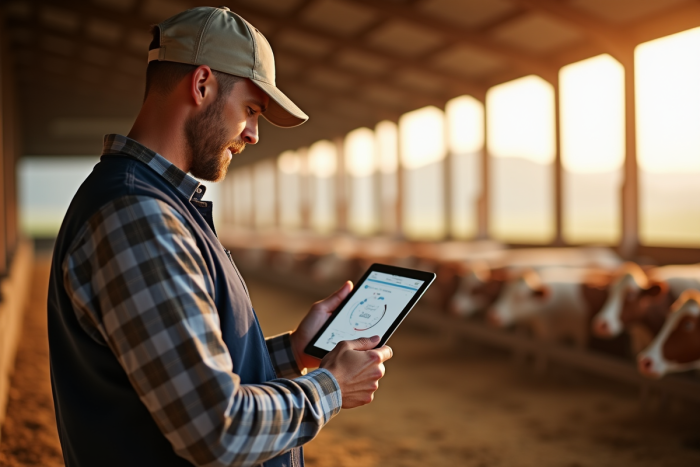
In France, more than 70% of farms use digital tools to manage their activities. However, the adoption of online solutions remains uneven across sectors, generations, or farm sizes. Some platforms have become essential for marketing, inventory management, or crop monitoring, while others struggle to convince.
This changing digital landscape directly influences agricultural practices, farm profitability, and the management of natural resources. The environmental and economic impacts of these innovations raise as many hopes as questions among industry professionals.
Agritech in daily life: how platforms are transforming the farmer’s profession
At the heart of farms, agritech is reshaping the contours of the profession. Online platforms are becoming part of the routine: digitized order books, automated stock tracking, yield analysis at the click of a button. Whether on computer or smartphone, agricultural management is shifting towards simplicity. Farmers navigate between refined weather forecasts, input price comparisons, and anticipation of logistical needs, all facilitated by digital tools.
Daily life is changing: now, just a few clicks are enough to access tools that were long reserved for larger structures. Agricultural production is accelerating thanks to digital technologies. Precise tracking of plots, traceability of harvests, exchanges of experiences among professionals… Platforms provide access to useful data analyses, speeding up decision-making and practice adjustments. Digital agriculture is asserting itself, concrete and tangible, supported by tools designed for every type of farm.
Some take an important step by creating a personal space, like with my Agrizone account. This space gathers orders, purchase history, and tailored recommendations. The interface, designed to be accessible, reduces the time spent on administrative tasks and allows for more focus on the field. Agtech is becoming part of daily life, transforming the way work is organized and how unexpected events are managed.
This rise of digital technology in agriculture requires the acquisition of new reflexes. Agricultural practices are evolving, driven by a wave of innovations and field tests. Generalist discourses sometimes struggle to account for the diversity of uses, caught between enthusiasm for technology and legitimate doubts. But in the fields, the digital transition is being experienced concretely, amidst economic ambitions, environmental requirements, and the social realities of the rural world.

Connected tools for more sustainable and efficient agriculture: what are the concrete impacts on the environment and productivity?
The massive arrival of connected tools is disrupting farm management. Sensors, connected weather stations, and agricultural data analysis systems pave the way for a more thoughtful use of inputs. Thanks to intra-field modulation, inputs, whether fertilizers or phytosanitary products, are adjusted as precisely as possible. This fine management helps preserve soils and limit greenhouse gas emissions.
Precision agriculture relies on the Internet of Things (IoT) and Geographic Information Systems (GIS). These technologies, widely deployed in France and supported by the FAO, provide a detailed view of plots and allow for real-time monitoring. The data collected via digital platforms assist at every stage, from sowing to harvest, supporting decisions with concrete information.
Here’s what these tools concretely change on the ground:
- Increased yield per hectare
- Reduction of losses through better anticipation of climatic hazards
- Optimized water management according to the specific needs of crops
These innovations translate into improved profitability and enhanced food security. Smart agriculture is emerging as a driver of sustainable development, capable of adapting its methods to climate challenges while meeting the demands for responsible food production and prudent management of natural resources.
As the seasons progress, digital tools are becoming embedded in agricultural daily life. The sector is advancing, propelled by an unprecedented alliance between passed-down know-how and digital data. It remains to be seen how far this synergy can transform, tomorrow, the way we produce and feed, and whether the bet on shared progress will hold its promises in the long term.