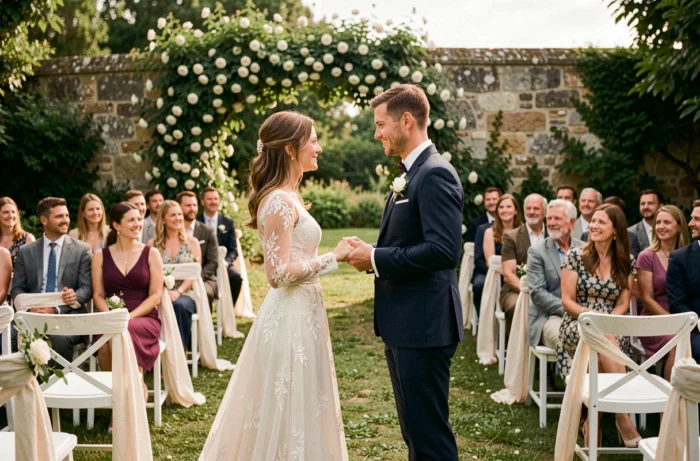
Organizing a wedding involves dozens of interdependent decisions, from the venue to the choice of caterer, including administrative procedures. Each expense category weighs differently on the overall budget, and the cost discrepancies between two seemingly close options can be surprising. This article outlines the essential steps to organize a wedding by measuring what truly affects the bill and the quality of the day.
Wedding Budget: The Most Significant Expense Categories
The majority of a wedding budget focuses on three categories: the venue, the caterer, and entertainment providers (photographer, DJ, musicians). The rest, including decoration, invitations, and outfits, represents a more modest but rarely negligible portion.
| Expense Category | Estimated Budget Share | Main Variable |
|---|---|---|
| Venue | Heaviest category | Season, day of the week, capacity |
| Caterer (meals + drinks) | Comparable to venue | Number of guests, seated or cocktail format |
| Photographer / videographer | Intermediate share | Duration of presence, album delivery |
| Floral decoration | Moderate share | Flower varieties, season |
| Musical entertainment | Moderate share | Live band vs DJ |
| Outfits and accessories | Variable share | Custom-made vs ready-to-wear |
This table highlights a frequently underestimated fact: the caterer and the venue alone absorb the majority of the budget. Significant savings can be made on these two lines, not on stationery.
For everything you need to know about Planifiez votre Mariage, the timeline starts precisely with securing the venue and the caterer, which condition everything else.

Caterer Quotes: Hidden Costs in Comparison
Comparing two caterer quotes based solely on price per guest gives a misleading picture. Additional fees can alter the actual cost by several dozen percent.
A quote displays a price per cover, but several items are often billed separately:
- Service staff (number of servers, overtime after midnight)
- Rental of dishes, tablecloths, and furniture if the venue does not provide them
- Setup and teardown fees, sometimes charged by the half-day
- Management of specific dietary requirements and allergies, which can incur an additional charge per affected cover
A caterer offering a lower per-person rate may turn out to be more expensive once these items are included. Reliable comparison relies on the total amount including VAT, service, and logistics fees.
Seated Meal or Cocktail Dinner
The meal format changes the game. A cocktail dinner reduces the need for furniture and floor staff, partially offsetting the cost of cocktail items (often more numerous than seated meal dishes). On the other hand, a seated meal better structures the flow of the evening and facilitates speeches.
Outdoor Venue: The Technical Plan That No One Checks Early Enough
The choice of venue goes beyond aesthetics. An outdoor venue requires a technical check from the first visit.
Three points deserve special attention:
- A covered backup space in case of rain, with sufficient capacity to accommodate all seated guests
- The site’s electrical capacity, which must simultaneously power sound systems, ambient lighting, and caterer’s equipment (ovens, refrigerators, coffee machines)
- The actual accessibility of pathways between the parking lot, ceremony site, restrooms, and reception area, including for people with reduced mobility on wet or sloped terrain
A lawn that seems ideal in June can become impassable after a downpour. Field reports indicate that accessibility is not limited to the entrance of the hall: each route between different areas must be evaluated separately.

Civil Ceremony and Secular Ceremony: What the Law Actually Requires
The secular ceremony is increasingly appealing to couples, but it has no legal effect in France. Only the civil marriage celebrated by a civil officer is recognized by law. A secular (or religious) ceremony is symbolic and must be organized as a complement.
From an administrative standpoint, the civil marriage requires a file submitted at the town hall several weeks before the date, including identity documents, proof of residence, birth certificates dated within the last three months, and a list of witnesses. The religious ceremony, if the couple desires one, must necessarily follow the town hall ceremony.
Acoustics of the Outdoor Ceremony
A rarely anticipated point concerns sound. Without an appropriate system, vows and readings become inaudible for some guests as soon as the ceremony takes place outdoors. Wind, distance, and ambient noise are enough to drown out an unamplified voice beyond the third row. Planning for portable sound is a modest investment that changes the experience of the entire ceremony.
Wedding Timeline: The Order of Decisions That Prevents Blockages
The order in which decisions are made affects the smoothness of preparations. Booking the photographer before securing the venue makes no sense if the date is not set. The venue and date form the foundation: all other providers depend on them.
The guest list should be stabilized early, as it determines the size of the venue, the number of covers for the caterer, and the volume of invitations. A discrepancy of twenty guests can shift a caterer quote from one range to another.
The administrative procedures at the town hall often require an underestimated timeframe. Some municipalities require a complete file to be submitted several months before the civil ceremony, and Saturday slots are booked well in advance, especially between May and September.
The last month before the wedding is ideally for adjustments (seating plan, provider confirmations, final fitting) and not for structural decisions. A couple who finalizes the venue, caterer, and guest list at least eight to ten months before the big day has sufficient leeway to absorb unforeseen events without disproportionate stress.