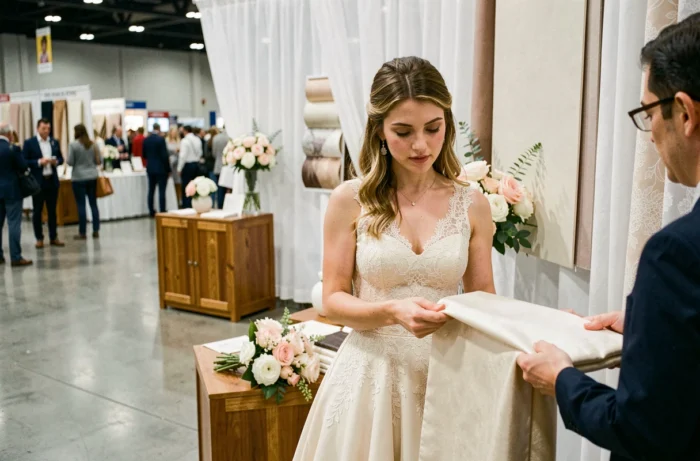
Organizing a wedding involves dozens of service providers, each with their rates, availability, and conditions. The wedding fair brings these professionals together in one place, over one or two days. This format allows for comparing offers, testing products, and asking technical questions face-to-face, without rushing from one appointment to another for weeks.
Hidden wedding costs: what the fair helps to identify before signing
Budget overruns are the number one stress for engaged couples. Most of the slip-ups do not come from the caterer or the venue, but from items that no one spontaneously mentions.
Industry professionals identify several recurring sources of additional costs: day-of coordination, shuttles, accommodation for guests, overtime for service providers, venue cleaning, and last-minute menu changes. On a typical quote received via email, these items rarely appear.
At a fair, face-to-face conversations change the game. You can ask a caterer what happens if you add ten guests three weeks before the date. You can question a DJ about the cost of an extra hour after midnight. These direct exchanges bring to light costs that brochures do not detail.
Events like Festimariage gather various providers in one space, making this comparison and direct questioning easier.
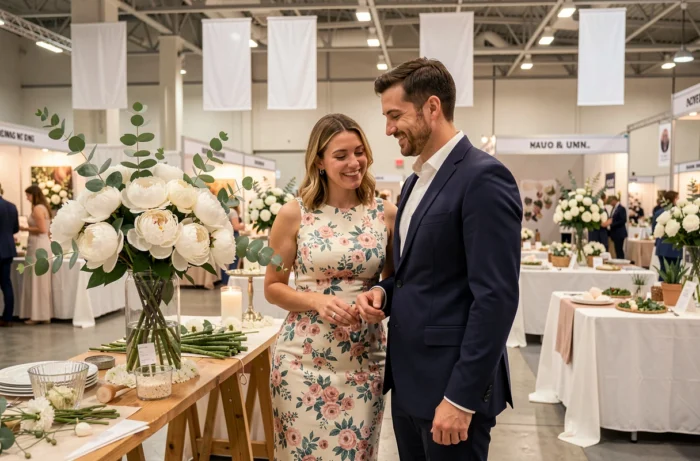
Multi-day weddings and micro-weddings: adapting your visit to the fair
Are you considering a full weekend with a welcome dinner on Friday, a ceremony on Saturday, and a brunch on Sunday? This format of multi-day weddings is clearly on the rise. It transforms the list of needs: group accommodation, transportation between sites, logistical coordination over two or three days.
A wedding fair then takes on a different dimension. It’s no longer just about finding a photographer and a florist, but about checking if a venue can accommodate your guests for two nights, or if a caterer is willing to handle three consecutive meals with different menus.
The case of the micro-wedding
On the opposite end, celebrations with a reduced guest list are gaining ground. The micro-wedding caters to a desire for personalization as well as a logic of savings. However, fixed costs do not decrease with the number of guests: photographer, musician, floral decoration, equipment rental remain the same whether you invite twenty or a hundred people.
At the fair, this reality becomes evident quickly. By comparing quotes from several providers, you can identify which ones offer packages suitable for small groups and which ones charge a non-negotiable minimum.
How to spot a reliable provider at a wedding fair
A well-decorated stand guarantees nothing. The profession of wedding planner, for example, remains unregulated in France: no state diploma is required to practice. This lack of framework makes your own vigilance all the more necessary.
Before committing to an exhibitor met at the fair, three checks deserve your attention:
- Professional liability insurance: ask for the contract number or a certificate. A serious provider will provide it without hesitation.
- Verifiable references: not just anonymous reviews, but contact details of former clients or dated portfolios with names of real venues.
- The precise contractual scope: what the service covers, what the limits are, what penalties apply in case of cancellation from either side.
A well-organized fair facilitates this process. Most select their exhibitors in advance, but this pre-selection does not replace your own verification.
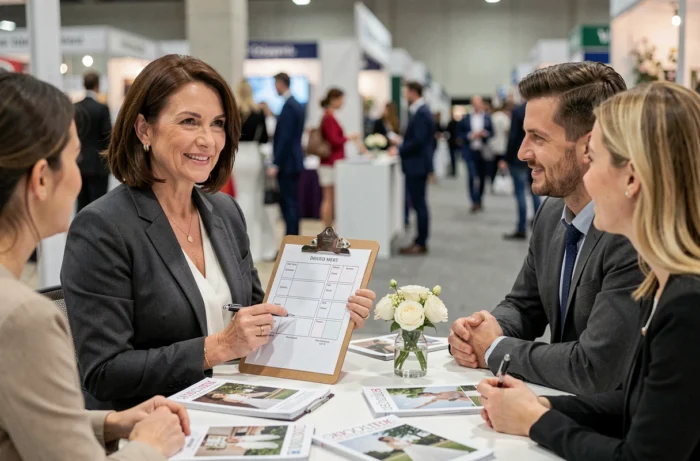
Preparing your visit to the fair for concrete benefits
Arriving without a list or defined budget turns the visit into a pleasant but unproductive stroll. A few preparation steps can change the outcome.
Start by setting a global budget range and breaking it down by category. Even if approximate, this breakdown allows you to immediately filter out providers outside your range. Next, list the priority items: those for which you have no contacts or ideas yet.
During the fair, focus on these priorities. Here’s what distinguishes an effective visit from a scattered one:
- Prepare three specific questions per category of provider (budget, availability, cancellation conditions).
- Note each exchange on your phone with the name of the stand and the direct contact, not just the business card.
- Compare at least two providers per category before validating anything on-site.
- Never sign a contract on the same day: a deposit paid under pressure remains the primary source of regret.
The fair’s activities (bridal fashion shows, culinary demonstrations, decoration showcases) serve to discover trends and concrete ideas. They complement the process but do not replace the work of active comparison.
The all-in-one trap
Some exhibitors offer packages that combine venue, catering, decoration, and entertainment. This format simplifies organization but makes negotiating item by item impossible. If the caterer does not suit you after the tasting, you have no leverage to replace them without questioning the entire contract.
A wedding fair remains one of the few moments when you can confront multiple professionals in a few hours, ask the tough questions about additional costs, and return home with tangible elements to decide. The condition: go prepared, with clear criteria and the firm intention not to sign anything on-site.