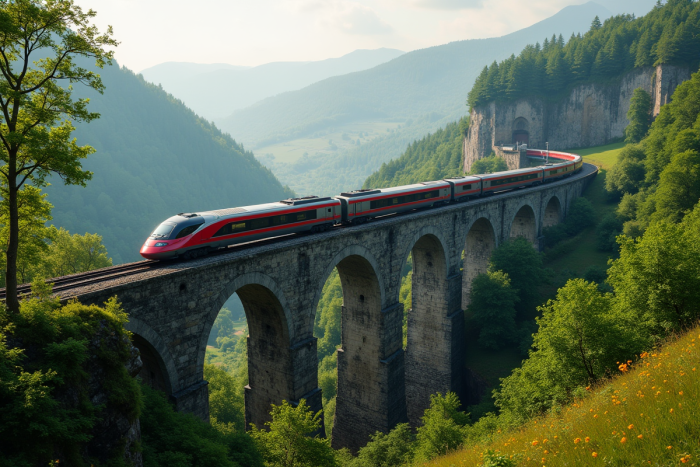
Seven countries crossed in one go, without changing locomotives: in Europe, some trains defy borders as easily as an email. Since 2022, the reality has shifted. On certain major routes, rail passes are now selling better than plane tickets. Yet, it only takes booking a high-speed journey to encounter another facet of European rail: mandatory fees, limited seats, and a feeling of freedom that is dwindling.
Each national company dictates its own rules: access to night trains reserved here, optional reservations there, fares that vary from country to country. As a result, the network is expanding, but harmonization leaves much to be desired. We are making progress, certainly, but each route retains its shadowy areas.
Why the train is becoming the best option for exploring Europe today
On the rail front, Europe has no equivalent. With over 200,000 kilometers of tracks, the continent connects its capitals as well as its villages, crosses mountains and plains, and allows travel without the burden of heavy administration. The European rail network stands out for its smooth connections, reliability, and the ability to traverse the map without cumbersome transitions.
The environmental advantage is also evident: taking the train means effortlessly reducing your carbon footprint. The companies, around fifty in total, compete in their commitment to make the option even more appealing. With the Interrail pass, the continent opens its doors: unlimited access to 33 countries, for a frankly affordable sum and without restrictive age conditions. This pass allows you to traverse Europe at your own pace, without having to choose each stop in advance.
In terms of comfort, it is far from a rigid journey: seats that can accommodate all body types, freedom to move around the carriage, no endless waiting at controls or under display screens. The pricing options allow all profiles—families, groups, young people—to find something that suits them. With Interrail, everyone can imagine a route that reflects their own, shaped by encounters and opportunities. The train then becomes a true human experience, quite different from the impersonal atmosphere of airports.
To get an idea of the richness of this mode of travel, here are some highlights that make European trains so remarkable:
- Journeys that shape memories: Swiss Alps, Austrian valleys, Eastern plains, each line embodies a part of the continent.
- Upon arrival, a new city, a culture, a history to grasp on the platform.
- The journey itself remains an adventure, far from the neutrality of quick flights.
Organization, for its part, is far from hermetic. Interactive maps, simple booking tools, passionate communities: it has never been easier to design your own itinerary. Taking the train means gaining the luxury of slowing down, observing each step, and reweaving the connection with Europe, differently.

Passes, itineraries, and tips: everything you need to know to organize your European rail journey
Embarking on a train journey across Europe is choosing controlled unpredictability. The Interrail pass remains the undisputed ally of mobile travelers: unlimited access to 33 countries, free for those under 11, discounted prices for those under 26. This encourages families or groups of friends to make multiple stops without breaking the bank. Only certain high-speed lines or night trains require a reservation with an additional fee, but the vast majority of the network can be used without extra constraints.
To build your itinerary and make the most of the best of European rail, there are offers and lines that stand out:
- Eurostar connects Paris to London, Brussels, or Amsterdam in just a few hours.
- The TGV reaches Milan or Rome from France without detours.
- Nightjet offers overnight journeys between capitals to save time and vary experiences.
- Glacier Express and Bernina Express provide unforgettable alpine panoramas between Switzerland and Italy.
- The Swiss Travel Pass travels throughout Switzerland, while the German D-Ticket gives access to all regional trains in Germany for €49 monthly.
To plan your trips and decode how the European rail network operates, the Cartotrain map quickly becomes essential. The guide “Traveling by Train in Europe” is full of practical advice, detailed routes, and traveler profiles. Illustrated in France and designed for everyone, it supports both groups and solo travelers. More than just another guide to slip into your bag, it suggests rethinking your relationship with travel, imagining other stops, and choosing the train as a project in itself.
The European train escapes the simple notion of transport. It becomes a space to explore, a bridge between cultures, an invitation to slow down, enjoy, and see Europe unfold differently. The next departure may already be at the station.