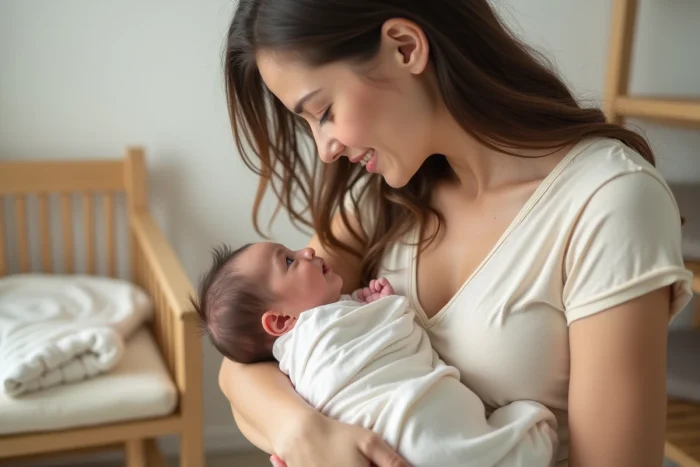
From birth, a newborn has sufficient sensory capabilities to distinguish their mother from another person. This recognition relies on three perceptual channels activated even before birth: smell, hearing, and later, vision. Understanding the order in which these channels develop allows for better interpretation of the baby’s reactions during their first months.
Newborn Sensory Recognition: Smell and Hearing Before Vision
The first sense utilized by the infant to identify their mother is smell. During intrauterine life, the fetus is immersed in amniotic fluid, the olfactory composition of which is linked to maternal diet and metabolism. After birth, the baby finds a similar chemical signature on the skin of the breast and neck of their mother.
This olfactory recognition is so early that a newborn placed on their mother’s stomach spontaneously crawls toward the breast. They do not follow a visual signal: they follow an odor trail they learned to recognize in utero.
Hearing operates on a parallel level. The fetus perceives low-frequency sounds filtered by the amniotic fluid as early as the third trimester of pregnancy. The maternal voice, also transmitted through bone conduction, thus has an acoustic advantage over any other voice. After birth, the infant turns their head toward this voice and calms down more quickly upon hearing it.
It is possible to find advice on Your Health Assistant to support these very first weeks of sensory bonding between the baby and their mother.
Vision, on the other hand, remains blurry in the first days. A newborn perceives contrasts at a distance of about one forearm’s length, which corresponds to the face-breast distance during breastfeeding or bottle-feeding. They do not yet distinguish the details of the maternal face but can identify the outline of the head and the boundary between hair and forehead.
Brain Activation in Response to the Mother’s Face: What Neuroimaging Studies Show
The question of whether the baby “really recognizes” their mother or simply reacts to a familiar stimulus has found an initial answer through neuroimaging. High-density EEG studies published between 2019 and 2023 in journals such as Developmental Cognitive Neuroscience have highlighted a specific activation to familiar faces in the temporal and occipital regions of the infant’s brain.
In other words, when a few-week-old baby sees their mother’s face, their brain activity differs from that recorded in response to an unfamiliar face. The recognition of the mother is not just an observable behavior (smiling, calming). It is a measurable brain process, detectable by sensors placed on the infant’s skull.
This point changes the usual interpretation of development. Before this research, visible reactions of the baby (crying, gaze orientation) were relied upon to estimate the age of recognition. Imaging shows that the brain is already processing the information “known face vs. unknown” long before the baby exhibits a clear behavioral preference.
Interactive Synchrony and the Quality of Mother-Baby Recognition
Age markers are useful, but they only tell part of the story. Recent work in developmental psychology, notably a synthesis by K. Rahkonen published in Child Development Perspectives, shows that maternal recognition is strongly co-constructed.
The central notion here is interactive synchrony. It refers to the mutual adjustment between the parent and the baby:
- The parent responds quickly to the baby’s signals (crying, movements, gaze), reinforcing the sensory trace associated with their presence.
- Eye contact is adjusted: neither fixed nor absent, it follows the infant’s attention rhythm, which alternates between phases of engagement and withdrawal.
- The tone of voice is contingent: it rises when the baby is actively awake, and lowers when the baby shows signs of fatigue.
What emerges from this research is that the quality of this synchrony predicts a more stable and soothing recognition for the baby, regardless of the exact amount of time the parent is present. A parent who is present for two hours a day with strong synchrony may be recognized more reliably than a parent who is constantly present but minimally responsive to the baby’s signals.
Premature Baby and Mother Recognition: A Delayed Timeline
The classic markers (smell from birth, clear vision by three months, separation anxiety between six and eight months) apply to full-term babies. For premature infants, the timeline shifts.
Longitudinal studies published in Infant Behavior and Development between 2021 and 2023 indicate that premature babies develop a fine recognition of their mother, but at their own pace. The gap varies depending on the degree of prematurity and the conditions of hospitalization.
A distinctive point: for these babies, touch and voice take on increased importance compared to the face. In the incubator, skin-to-skin contact (kangaroo method) and the parent’s voice are the most accessible sensory channels. Visual recognition of the face comes later, once the baby has reached sufficient visual maturity.
This delay does not indicate a deficit in the quality of the bond. It reflects an adaptation of the baby’s perceptual system to the conditions of their early weeks of life.
From Sensory Recognition to Attachment Bond
Recognizing their mother and forming an attachment are two related but distinct processes. Sensory recognition begins before birth. The attachment bond, as described by attachment theory, is built over months through repeated interactions.
Dr. Anne Raynaud, psychiatrist and founder of the Parenting Institute, specifies that the baby attaches to the attachment figure, meaning the person who cares for them daily. This figure is often the biological mother, but not always.
By six to eight months, most babies show a marked preference for this figure: crying in their absence, calming quickly upon their return. This behavior indicates the establishment of an organized attachment bond, which is based on months of accumulated sensory recognition.
The baby’s ability to distinguish their mother is therefore not a one-time event but a gradual, multisensory process that depends on the quality of interactions much more than simply the amount of time spent together.