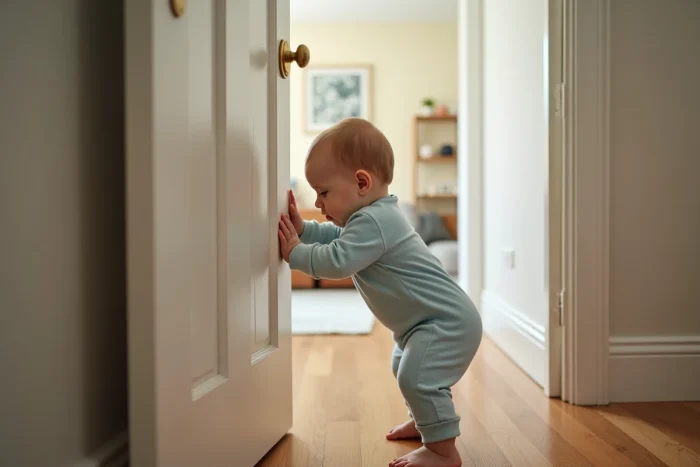
An child’s ability to operate a door handle does not solely depend on their age. It relies on two specific motor prerequisites: the pincer grip strength and bilateral coordination, meaning the ability to stabilize the door leaf with one hand while the other turns the handle. Without these two combined skills, the child can pull or push, but cannot actually open the door.
Pincer strength and bilateral coordination: the true motor prerequisites
Studies in pediatric occupational therapy published since 2021 confirm that the ability to turn a standard handle is correlated with pincer strength and bilateral coordination, not just chronological age. A child aged 14 to 18 months can open a soft horizontal handle door, while a 2-year-old will struggle with a rigid round handle or a high lock.
The distinction between types of handles changes everything. A horizontal lever handle is operated by simply pressing down: the action is similar to palm pressing, accessible early on. A round handle requires wrist rotation combined with a firm grip, which demands more fine motor skills. We observe that parents often underestimate this mechanical difference.
To find out at what age a baby opens doors, one must look beyond the developmental calendar and assess the type of mechanism present in the home. The same child may be able to open their bedroom door but get stuck in front of the bathroom door.
Door opening and the risk of accidental escape between 18 months and 3 years
Opening doors (entrance, balcony, basement) is now identified as a major risk marker for accidental escape between 18 months and 3 years, alongside climbing barriers and opening windows. Several pediatric and maternal-child health services have systematically included a question about the child’s ability to open doors alone during 24-month check-ups.
This risk is not theoretical. The media coverage of cases of young children leaving their homes through the front door has led to a significant increase in demand for door stoppers and safety handles specifically designed for toddlers since 2022. Hardware manufacturers have developed dedicated ranges in direct response to this scenario.
Which doors to prioritize monitoring
The front door remains the most critical: it opens directly to the outside, often without an intermediate safety landing. The balcony door comes second, especially in multi-story homes. Basement or garage doors present an additional fall risk related to stairs.
We recommend assessing each door in the home not by its weight or size, but by the ease of its opening mechanism and the proximity of a direct danger (drop, road, stairs).
Types of handles and safety devices suitable for each motor stage
The choice of safety device must correspond to the child’s motor stage, not to a generic age range printed on the packaging. Here are the technical criteria to consider:
- Handle stoppers encompass the handle and prevent any rotation. They are effective as long as the child does not master the lateral compression gesture, generally until around 3 years old.
- High locks (above 1.40 m) remain out of reach as long as the child does not climb on furniture. Their effectiveness ends when the child starts moving objects to climb.
- Double action handles (pressing and turning simultaneously) require bilateral coordination that most children do not master until 3 to 4 years old.
- Door stops on the floor prevent complete closure but do not block opening: they protect fingers, not against escape.
A device poorly suited to the existing door mechanism loses all effectiveness. Checking the compatibility between the type of handle (round, lever, knob) and the door stopper before purchase avoids unnecessary returns.
Supporting fine motor skills without blocking exploration
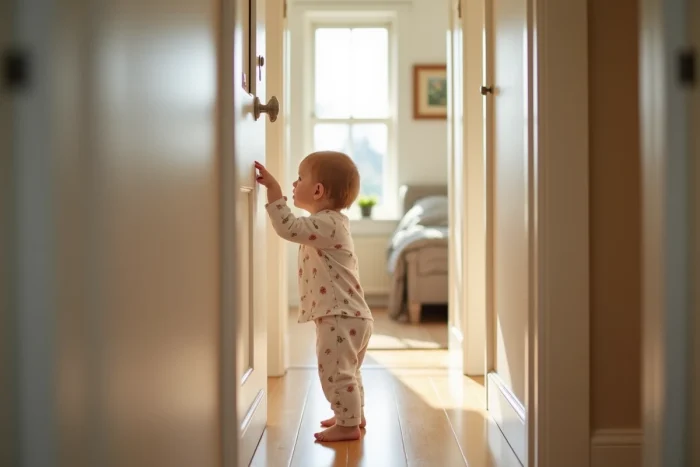
Completely preventing a child from interacting with doors hinders the development of their fine motor skills and autonomy. The goal is not to eliminate the action but to channel it towards safe spaces.
An interior door leading to a safe room (bedroom, closed living room) can serve as a training ground. The child practices wrist rotation, pulling gestures, and coordination of both hands there. These skills will serve them well beyond opening doors: they are involved in screwing, rotational drawing, and dressing.
Complementary activities to strengthen the pincer grip and rotation
Some activities specifically target the same muscle groups and motor patterns as door opening:
- Screwing and unscrewing jar lids of various sizes engages wrist rotation under load.
- Turning knobs on shape sorters or stacking toys works the three-finger grip.
- Opening and closing key locks (suitable toys) combines fine rotation and bilateral coordination.
These activities do not replace securing high-risk doors, but they allow the child to develop underlying motor skills in a controlled setting.
The issue of a toddler opening doors is as much about accident prevention as it is about monitoring motor development. Adapting safety to the actual mechanism of each door in the home, rather than relying on a theoretical age, remains the most reliable strategy for both parents and early childhood professionals.